


Sabzi Polo Mahi
Overview
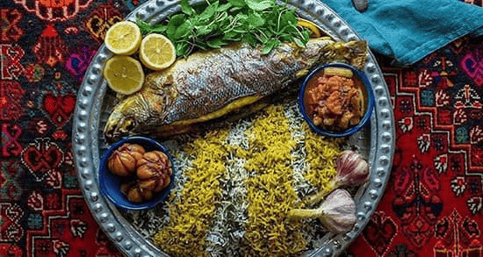
Sabzi Polo Mahi can be translated as "herbed rice with fish." In Persian, sabzi refers to fresh herbs or greens, polo refers to a particular form of cooked rice, and Mahi means fish. The name therefore directly identifies the three principal components of the dish. In its most familiar form, Sabzi Polo Mahi consists of fried, grilled, or roasted fish served with rice prepared with finely chopped aromatic herbs, most commonly dill, parsley, coriander, chives, or leeks, and occasionally fenugreek.
History & Cultural Significance
For Iranians, Sabzi Polo Mahi represents more than a seafood dish. It is strongly associated with Nowruz, the Iranian New Year and spring festival, and is commonly prepared around Shab e Nowruz, the night before the new year begins. Its smell and color during cooking have become part of the sensory experience of Nowruz itself. UNESCO describes Nowruz as a shared spring celebration observed across several countries in Asia, celebrating the new year and symbolizing the revival of nature through ceremonies, family gatherings, special decorations, and specific dishes . Although individual recipes vary by region, family tradition, and available ingredients, food in this sense is not simply an accompaniment to Nowruz. In fact, it’s one of the practices through which the festival is experienced and passed down between generations.
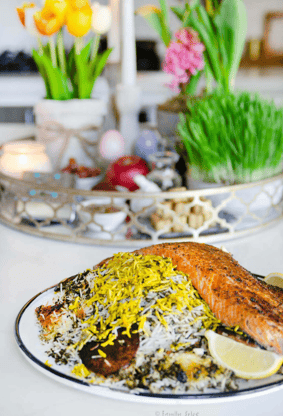
The widespread recognition of Sabzi Polo Mahi distinguishes this food from many Iranian dishes that remain closely associated with a particular province. The culinary geography of Iran is extremely diverse, and local cuisines have historically developed in relation to climate, agriculture, pastoral practices, available ingredients, and patterns of trade. Nevertheless, the preparation of Sabzi Polo Mahi for Nowruz extends beyond the coastal regions, such as regions around the Persian Gulf and the Caspian Sea. It was extended to arid and semi-arid areas in the central part of Iran. Fish could travel beyond its immediate geographical environment through preservation and trade, and in this sense, Sabzi Polo Mahi can be approached as a dish whose cultural meaning has moved beyond the geographical origins of its individual ingredients and entered a broader Iranian festive tradition. Traditional methods of preserving fish included salting, smoking, and drying. These techniques provided the necessary conditions for fish to be transported, stored, and consumed.
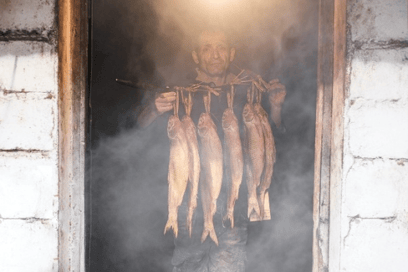
For example, historical evidence shows that, in Kashan, a city in the central part of Iran with an arid climate, where fresh fish is not simply accessible, people ate smoked fish on their important occasions.
These adaptations can be understood through the concept of ritualization, which means rituals are not fixed in material form but are reproduced and adjusted as circumstances change (Bell, 1992). Using different types of fish does not weaken the authenticity of Nowruz. Instead, it allows the tradition to be practiced under different conditions. The fish species, preservation method, and preparation technique can all change, yet the connection between fish and Nowruz remains recognizable.
Having a fish dish for Nowruz is not limited to Iran. Fish also appears in the New Year food traditions of some other communities that celebrate Nowruz, although their recipes, geographical distribution, and cultural meanings differ considerably. This broader regional context is important because it places the Iranian practice within the larger cultural geography of Nowruz while avoiding the assumption that all Nowruz-celebrating societies share an identical culinary tradition.
In Afghanistan, for example, ‘’Fish and Jalebi" is the most recognizable dish, served for New Year's Eve. Reports from Afghan markets describe a considerable increase in fish sales as Nowruz approaches (Haidari, 2023). In Azerbaijan, particularly in the southern region around Lankaran and the Talysh cultural area, a characteristic preparation is balıq ləvəngisi, or fish lavangi, in which a whole fish is filled with a mixture that typically includes walnuts, onions, sour fruit, and pomegranate-based seasoning before being baked. Lavangi has an important place in the regional food culture of southern Azerbaijan and is associated with festive tables, including Nowruz celebrations.
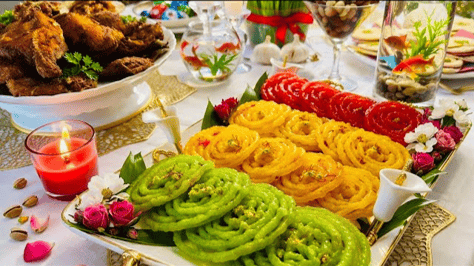
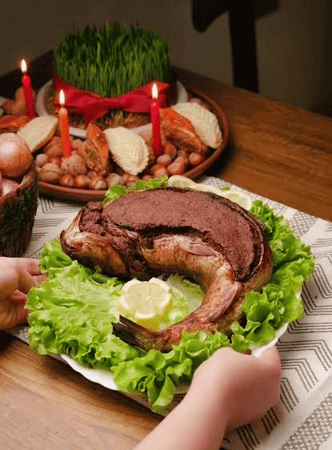
The appearance of fish as a principal component of Nowruz meals beyond Iran’s border cannot be entirely coincidental. It may suggest that fish plays a role beyond a simple meal and carries cultural or symbolic significance in Nowruz traditions.
Beyond these regional culinary comparisons, fish carries a deeper set of symbolic and mythological associations within Iranian culture itself. It is not currently possible to determine precisely when fish became part of the Iranian Nowruz meal or when the specific combination now known as Sabzi Polo Mahi first emerged. The absence of early documentary evidence for the complete dish makes it impossible to demonstrate an uninterrupted culinary tradition from antiquity. Nevertheless, archaeological and textual evidence indicates that fish had a visible presence in the material and symbolic culture of the Iranian world long before the modern Nowruz dish can be documented.
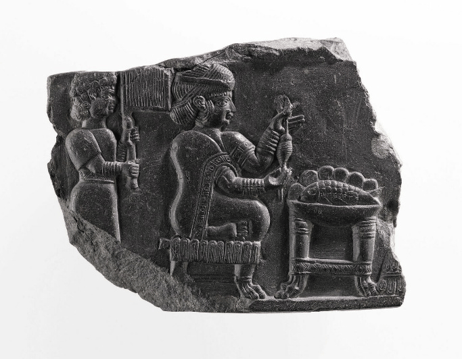
One of the earliest relevant archaeological examples is the Neo-Elamite relief known as La Fileuse, meaning "The Spinner," discovered at Susa and now preserved in the Louver Museum. The object is dated broadly between approximately 900 and 600 BCE. It depicts a seated woman holding a spindle, accompanied by another female figure. In front of the seated woman is a table containing food, including a clearly recognizable fish. The precise identity of the woman and the meaning of the scene remain uncertain. Consequently, the object should not be described as direct evidence of a religious fish ritual or of Nowruz. Its importance lies instead in demonstrating the very early visual presence of fish within the material culture of ancient Iran.
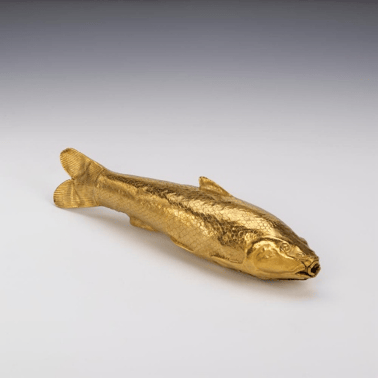
Another example is the hollow gold fish from the Oxus Treasure, held at the British Museum and dated to the Achaemenid period (5th–4th century BCE). Made from hammered gold sheet with detailed scales and fins, its exact function is unclear; the museum suggests it may have held oil or perfume (The British Museum, n.d.) (Moradi, 2015). Although this object cannot be used as direct evidence that fish held a sacred meaning in ancient Iranian culture or that it was associated with Nowruz, the use of gold sheets and the remarkable attention to detail in its craftsmanship suggest that the fish form was considered significant enough to be represented in an object of considerable material and artistic value.
Fish also appear in Zoroastrian mythology. The Bundahišn, a Middle Persian text on Zoroastrian cosmology compiled in the Islamic period from older traditions, describes a great mythical fish, Kara mahi, that guards the cosmic sea and fights against demonic forces of evil (The Bundahishn, 1880). Some writers link this myth to the tradition of eating fish on Nowruz. They suggest this practice may symbolically echo Kara mahi's battle against evil and impurity, and fish standing in for this victory of light over devil forces. A Sasanian plate at the National Museum of Iran, possibly showing a spring or Nowruz scene with a fish, is sometimes cited in support of this idea.
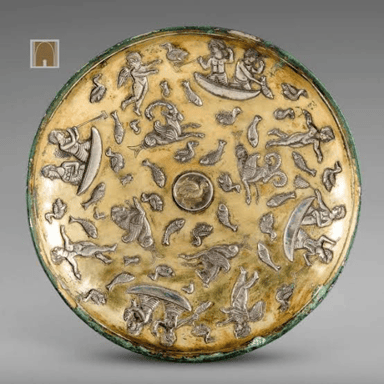
This remains an interpretation, not an established fact. There is not enough evidence to say Iranians began eating fish at Nowruz specifically because of Kara mahi, or that today's dish descends directly from ancient ritual. What the evidence does show is that fish carried symbolic and cosmological meaning in Iranian tradition long before the modern Nowruz meal can be documented.
The importance of Sabzi Polo Mahi at Nowruz extends beyond the fish. Sabzi polo (herbed rice) is another important part of the dish, and the choice of ingredients is based not only on taste but also on geography and what is locally available. It also has cultural and symbolic significance in Iranian traditions and Nowruz. As with the fish, the recipe for sabzi polo may vary across different regions of Iran depending on local ingredients and cooking traditions. The types and amounts of herbs may be different from one region or family to another, but the main character of the dish remains the same. Rice was not historically an equally accessible everyday food across Iran. It was central in the Caspian lowlands, while wheat and bread remained the staple across much of the plateau (Bromberger & Bazin, 1989). Outside the main rice-growing regions, rice and meat were expensive well into the twentieth century (Floor, 2021). In the city of Kashan, rice was so costly that poorer households could typically afford it only on a few occasions each year, including the eve of Nowruz (Borjian, 2012). While there isn't enough direct evidence to call rice a fixed symbol of wealth, its cost and its association with hospitality and celebration make it reasonable to read its place in the New Year meal as an expression of abundance and the wish to begin the year with a generous table.
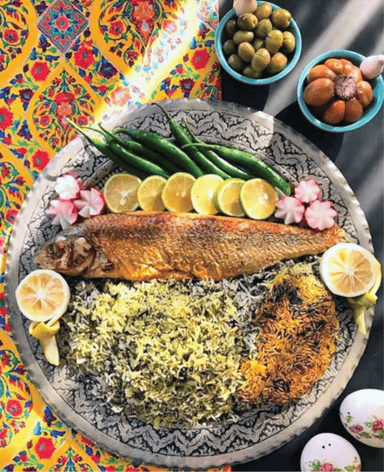
The choice of herbs in Sabzi Polo Mahi also extends beyond considerations of taste. The green color of the rice participates in the broader symbolic vocabulary of Nowruz, and is explicitly associated with the revival of nature. Green plants, germination, and new growth recur in Nowruz practices as material representations of seasonal renewal (UNESCO, 2024). A clear example is sabzeh, the sprouted wheat, barley, or lentils grown for the Nowruz decoration. The presence of sabzeh on the Nowruz table represents nature's return to life after winter and serves as a symbol of life, growth, and renewal (UNESCO, 2025).The herbs in Sabzi Polo Mahi follow the same idea. They are often described as representing nature returning to life at the start of spring, so their role is both culinary and symbolic.
importance of Sabzi Polo Mahi cannot be understood only through historical texts or the symbolic interpretation of its ingredients. Food also serves as a form of collective memory. Repeated preparation associates particular smells, tastes, gestures, and family gatherings with specific times in the calendar. Over time, the dish becomes capable of recalling not only a flavor but also the context in which that flavor was repeatedly experienced.
Using Iranians living outside Iran as an example can help clarify this function and make it easier to understand. Migration changes many of the material conditions that once surrounded Nowruz. For example, Specific varieties of fish are no longer available. The familiar combination of fresh herbs may require substitution. Or, the timing of the holiday may conflict with working schedules. Yet such changes do not necessarily eliminate the tradition. Instead, the practice can be modified in ways that make its continuation possible.
Survey about Sabzi Polo Mahi
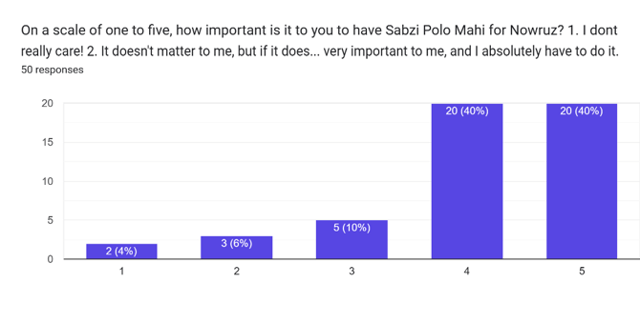
To investigate the relationship between food, cultural memory, and migration, a survey was conducted among 50 Iranians living outside Iran. Participants were asked how often they eat Sabzi Polo Mahi during Nowruz, the dish's importance to them, its cultural and personal meaning, their access to ingredients, and the importance of preserving the tradition. The results show a strong attachment to Sabzi Polo Mahi as part of Nowruz. 80% of participants rated having the dish for Nowruz as important or very important, and 86% reported eating it every year or in most years. Its meaning also went beyond food itself.
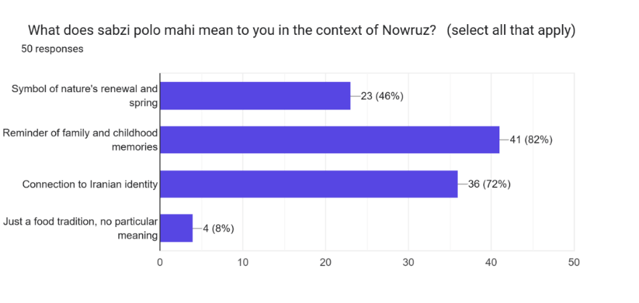
The majority of participants associated Sabzi Polo Mahi with family and childhood memories, as well as their Iranian identity, while many also connected it with spring and the renewal of nature. More than half of the participants also reported that the dish had gained a deeper meaning after migration or compared with the previous generation.
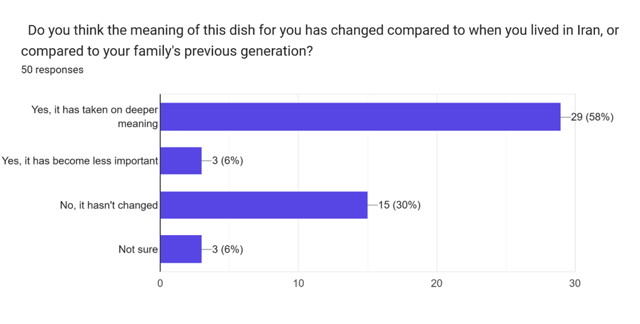
These responses suggest that Sabzi Polo Mahi functions as a form of cultural and sensory memory for many Iranians in the diaspora. Although many participants reported some difficulty in finding the necessary ingredients, most continued the tradition by adapting recipes or using alternative sources. This suggests that preserving the tradition does not require a single fixed recipe or a specific type of fish. Instead, its continuity depends on passing on the memories, meanings, and practices connected to the dish.
Ingredients
Basmati rice
Fresh dill
Fresh parsley
Fresh coriander
Fresh chives or green garlic
Fish fillets or whole fish
Lemon
Turmeric
Black pepper
Salt
Vegetable Oil
Butter
Potato or lavash bread for tahdig
Recipe
Preparation Method
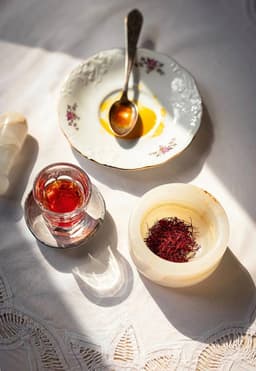
Step 1: Prepare the saffron. Grind the saffron threads and pour hot water over them. Cover and leave for about 10–15 minutes until the colour and aroma are released.
Step 2: Prepare the rice. Rinse the rice several times until the water runs clear, then soak it in salted water for about 30 minutes.

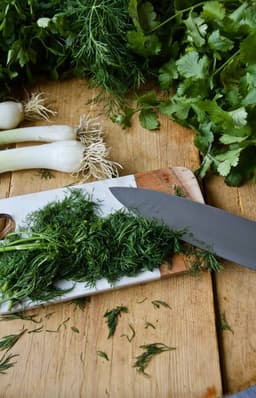
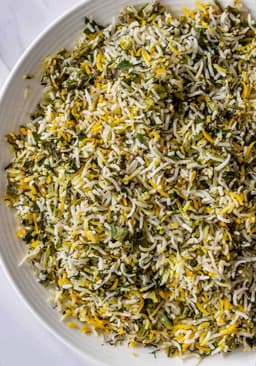
Step 3: Prepare the herbs. Wash and finely chop the dill, parsley, coriander, and chives or green garlic. Mix them together.
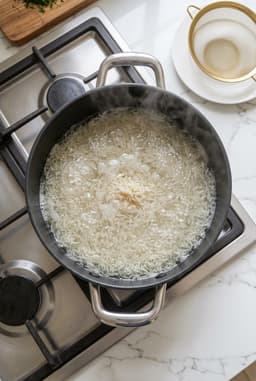
Step 4: Parboil the rice. Bring a large pot of salted water to a boil. Add the drained rice and cook for about 5–7 minutes, until the grains are soft on the outside but still slightly firm in the centre. Drain the rice.
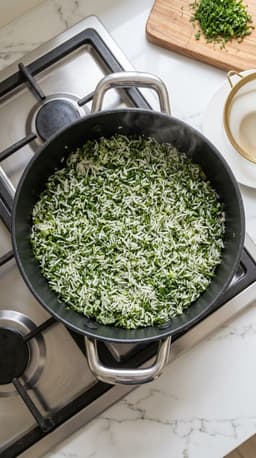
Step 5: Layer the rice and herbs. Add a little oil to the bottom of the pot. If desired, place sliced potatoes or lavash bread at the bottom for tahdig. Add the rice and chopped herbs in alternating layers.
Step 6: Steam the Sabzi Polo. Make a few holes in the rice with the handle of a spoon. Pour a little melted butter or oil over the top, cover the lid with a clean kitchen towel, and steam over low heat for about 35–40 minutes.

Step 7: Season the fish. Season the fish with salt, black pepper, turmeric, lemon juice, and a little brewed saffron. Leave it to marinate for about 15 minutes.
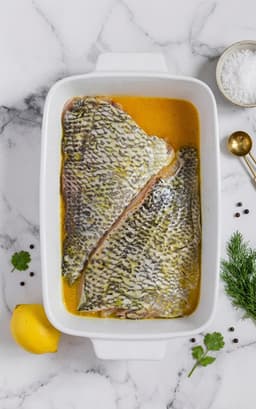
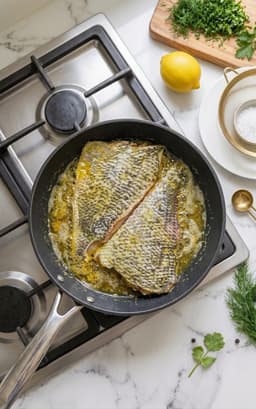
Step 8: Cook the fish. Heat oil in a frying pan and fry the fish over medium heat until golden and cooked through, approximately 4–6 minutes on each side depending on its thickness.
Step 9: Add the saffron rice. Mix a small amount of cooked rice with the remaining brewed saffron and spread it over the top of the Sabzi Polo.
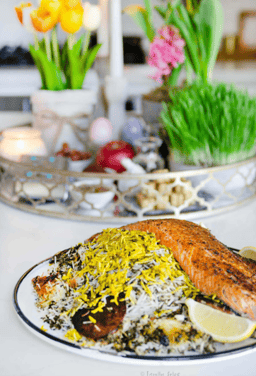
Step 10: Serve. Serve the Sabzi Polo hot with the fried fish, tahdig, fresh lemon, and fresh herbs.
💡 Chef's Tips
Fresh herbs provide the best aroma, but dried dill can be used when fresh herbs are unavailable.
Do not fully cook the rice during boiling. It finishes cooking while steaming.
Grinding the saffron before brewing helps release more colour and aroma.
Potato or lavash bread can be placed at the bottom of the pot for a crispy tahdig.
References
- 12012
Kashan vi. The Esbandi Festival
by Borjian, H.
https://www.iranicaonline.org/articles/kashan-vi-the-esbandi-festival/Retrieved from Encyclopaedia Iranica.
- 21989
BERENJ “Rice” i. In Iran
by Bromberger, Christian, & Bazin, Marcel
https://www.iranicaonline.org/articles/berenj-rice/berenj-rice-i-in-iran/Retrieved from Encyclopaedia Iranica.
- 32024
Nawrouz, Novruz, Nowrouz, Nowrouz, Nawrouz, Nauryz, Nooruz, Nowruz, Navruz, Nevruz, Nowruz, Navruz
by UNESCO
https://ich.unesco.org/en/RL/nawrouz-novruz-nowrouz-nowrouz-nawrouz-nauryz-nooruz-nowruz-navruz-nevruz-nowruz-navruz-02097Retrieved from UNESCO Intangible Cultural Heritage
- 42025
Culture of Sumanak/Sumalak Cooking
by UNESCO
https://ich.unesco.org/en/RL/culture-of-sumanak-sumalak-cooking-02336Retrieved from UNESCO Intangible Cultural Heritage
Music
Comments
No comments yet. If you know this dish — how your family makes it, what it is served with, when it appears — please add what you know.