
Listen to pronunciation
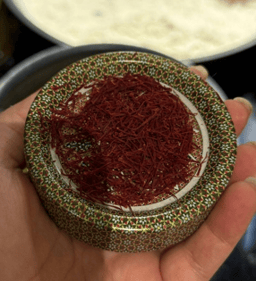
Saffron comes from the dried stigmas of a small purple flower called Crocus sativus. It is often treated only as an expensive spice, but its long history shows that it has always carried a much wider meaning.
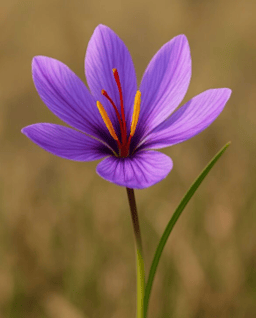
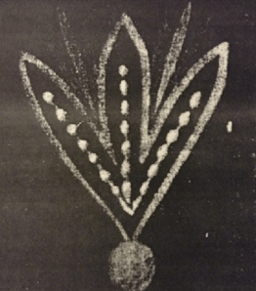
The exact origin of cultivated saffron is still debated among specialists. Most trace it to a wild flower called Crocus cartwrightianus, native to the eastern Mediterranean region. Over time, humans selected and bred this flower for its unusually long stigmas, until it developed into the sterile plant known today .The earliest clear written record of saffron appears in an Assyrian botanical text from the seventh century BCE, introducing saffron as a medicine to treat dyspnea, painful urination, menstrual disorders, and "diseases of the head". Material evidence, however, is even older. The earliest known depiction of a crocus flower in Bronze Age Aegean art appears on a Kamares cup from the Town Drain at Knossos, dated to around 2100 to 1875 BCE, well before the more detailed saffron harvesting scenes of later Minoan frescoes.
Bronze Age wall paintings from Minoan Crete and the island of Santorini show women gathering the flower, and in one scene, a blue monkey with mythological meaning is shown collecting crocus flowers and presenting them to a seated goddess who oversees the harvest.
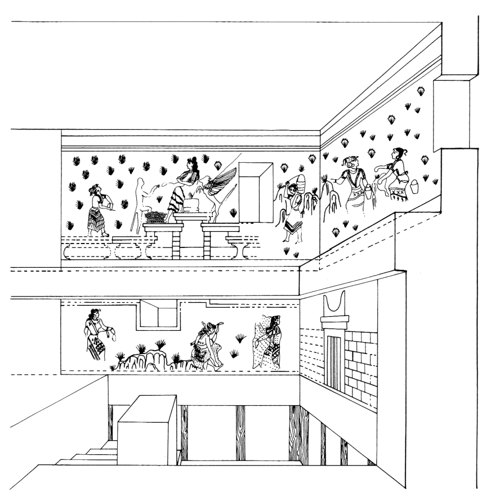
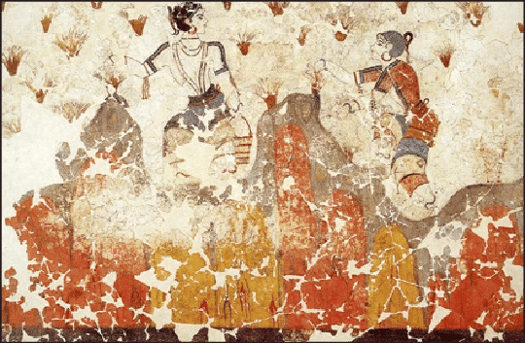
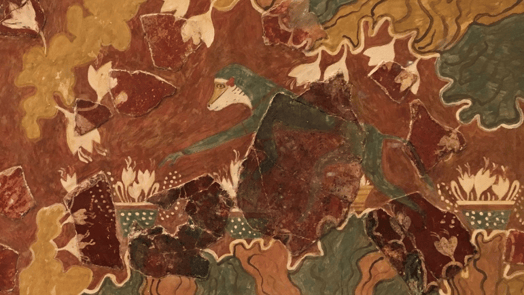
Another painting shows the goddess wounded at the foot, with her blood flowing into a crocus flower and turning its stigma red. This image closely resembles a separate Greek myth, in which a young man named Krokos is struck on the head during a ball game with the god Hermes, and his blood likewise gives rise to the first crocus flower with its red thread. This version of the myth is preserved through the medieval Iranian scholar Biruni, who records it on the authority of the Greek physician Galen.
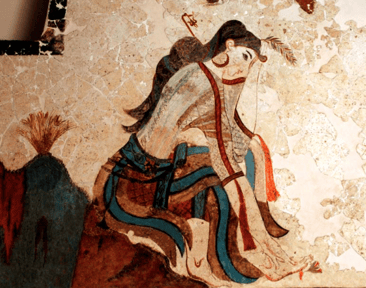
The similarity between these two stories suggests that the connection between saffron's color and themes of sacrifice and transformation existed in more than one ancient culture, even where the specific stories differ.
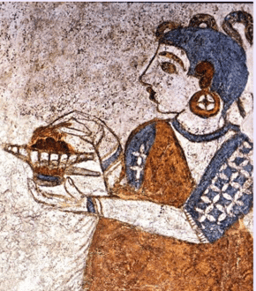
Within Iran, saffron's history is closely tied to its ancient language and its royal courts. A study of its etymology and early use traces terms connected to saffron through the Achaemenid and Sassanian periods, including the word kurkum, which linked the plant to sacred colour and dye in early Persian usage . Saffron also appears among the luxury goods associated with the Achaemenid court at Persepolis. It is said that Darius the First used a mixture of saffron and milk as a body perfume. This claim cannot be fully confirmed, but it reflects how strongly saffron was already linked with royal luxury in this period.
The word ‘’saffron’’ itself might have Persian roots. This word most likely reaches us through a chain of borrowing, from the Arabic word za'faran, which may itself derive from an older Persian term, zarparan, understood by some to mean "golden leaves".
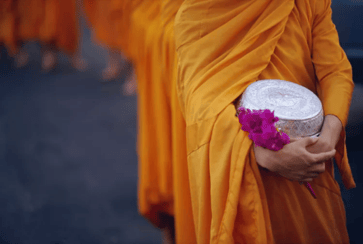
By around 500 BCE, saffron had already spread well beyond its region of origin. Persian traders are said to have carried it into the Indian subcontinent, including the Kashmir valley, as part of a wider expansion of Persian trade networks. This is only one of several competing accounts of how saffron cultivation began in that region. Buddhist monastic traditions, for example, became strongly associated with saffron coloured robes, a tradition still visible today in the orange robes worn by monks across parts of Southeast Asia. In Homer’s Iliad, Eos, the personification of Dawn, is repeatedly described as “saffron-robed,” with the colored garment accompanying her emergence at the beginning of the day and her role in bringing light to gods and mortals. This imagery may also be interpreted symbolically in relation to saffron, as the flowers are traditionally harvested in the early morning, shortly before or around sunrise. Although various references use the term “saffron-coloured robes,” there is no academic evidence directly confirming that the colour of the fabric was produced using saffron. Therefore, this claim cannot be made with certainty.
Saffron also traveled west through trade and conquest. Alexander the Great is reported to have drunk saffron tea and eaten saffron coloured rice during his military campaigns, and to have added saffron to his bathwater, believing it helped heal wounds from battle. Around 100 BCE, the plant also reached China, carried along trade routes such as the Silk Road, and the Roman Empire imported much of its own saffron supply from Persia as well.
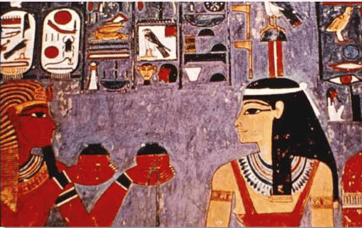
Saffron's link to luxury was not limited to Persia. In ancient Egypt, a banquet poem describes saffron oil being offered to a loved one together with lotus flowers, as part of a pleasure reserved for the wealthy. Cleopatra, the last active ruler of Ptolemaic Egypt, is said to have used saffron in her bath for its color and beauty, and, according to tradition, before meetings with men, believing that its scent had an enchanting quality.
After the defeat of the Persian and Roman Empires by Arabs, saffron cultivation spread further toward Europe. It reached Spain, and later southern France, under Arab rule, when Arab cooking made wide use of herbs and spices and valued saffron highly for its double role as both a coloring agent and a flavoring.
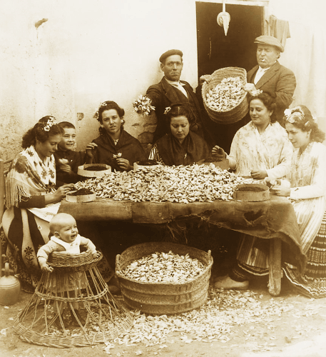
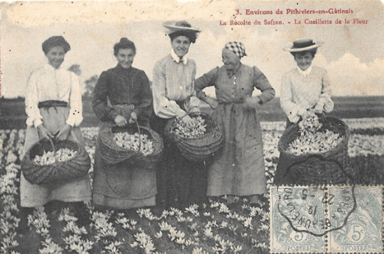
Cultivation later became firmly established in France, during the seventeenth and eighteenth centuries, spreading across much of the kingdom, and reached England by around 1350.
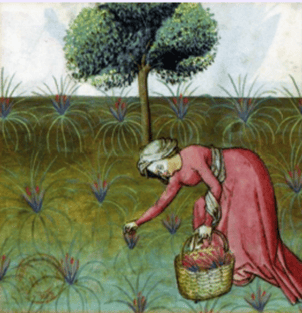
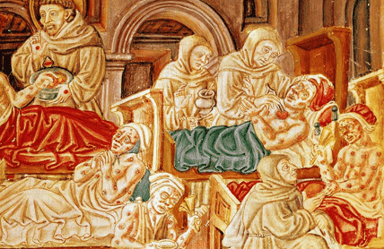
In medieval Europe, saffron's value could rise sharply. During the Black Death, demand for saffron increased greatly, since plague sufferers believed it could help treat their illness, making the spice even more valuable and, at times, dangerous to possess.
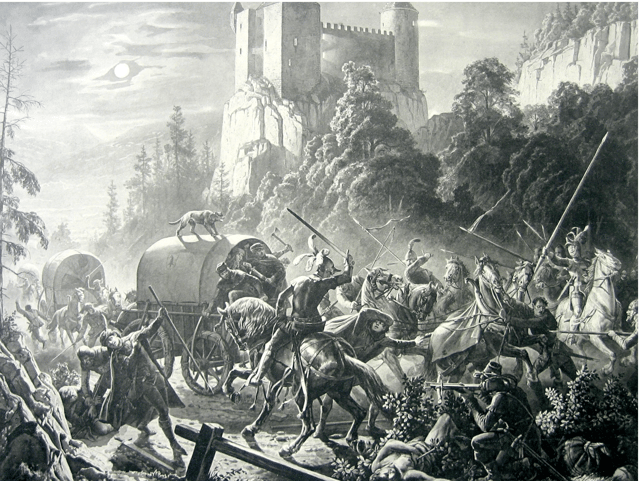
One documented event from this period is known as the "Saffron War." In 1374, the Bishop of Basel, Johann von Vienne, had made use of the military services of a local baron, Henmann von Bechburg, without paying him. In response, the baron attacked merchants travelling toward Basel and seized a shipment of roughly 800 pounds of saffron, worth several hundred thousand dollars in today's terms, holding it in his castle. The resulting conflict lasted about fourteen weeks and is remembered as the Saffron War. It ended only after Leopold of Austria negotiated a peace in which the bishop agreed to cover the baron's costs and cede the town of Kleinbasel, in exchange for the saffron's return to the merchants. Wary of further theft, the citizens of Basel began growing their own saffron, and prospered from it for roughly a decade, until the local crop failed and cultivation was abandoned. The centre of the European saffron trade then shifted to Nuremberg, where strict laws known as the Safranschou code were introduced against counterfeit saffron, with penalties that could include fines, imprisonment, or execution (Willard, 2002).
Saffron cultivation depends on specific climatic and soil conditions. These conditions include hot, dry summers and cold to mild winters, with sandy or loamy soils with Excellent drainage that can provide sufficient moisture for the corm to rot (Pirasteh-Anosheh, et al., 2023). The arid and semi-arid climate of the Iranian Plateau provides ideal conditions for saffron cultivation and allows the country to produce over 90% of the world's saffron. Nowadays, the eastern part of Iran, specifically the Khorasan region, has become one of the most important areas of saffron production (FAO, 2018). Nevertheless, saffron's origin does not begin in Khorasan. Historical accounts place the earliest large scale Iranian cultivation in the village of Rudavar, near Tuyserkan in Hamadan province, at the foot of Mount Alvand, an area said to have gained a wide reputation for its saffron exports as early as the Sassanian period, according to the medieval geographer Ibn Faqih (Abrishami, 2011).
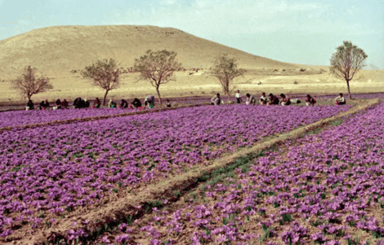
Other historical accounts place early Iranian saffron cultivation around the tenth century BCE in Darband and Isfahan, where saffron threads are reported to have been woven into royal carpets and funeral shrouds (Kazemi-Shahandashti, et al., 2022). From these central and western regions of Iran, cultivation gradually moved eastward. Sassanian era texts describe saffron farming spreading to areas such as Qom and Bavan, and from there into the wider regions of Transoxiana and Khorasan, until high quality production eventually became concentrated in Qohestan and, more specifically, the Qaenat region, now considered the capital of Saffron (Abrishami, 1987).
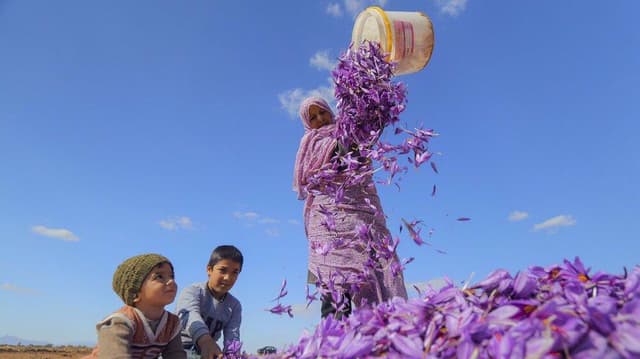
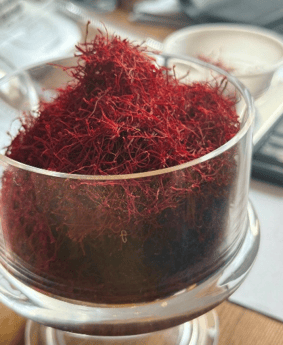
Saffron's price has always shaped its cultural meaning, in Iran as much as anywhere else. Each flower yields only three fragile stigmas, and roughly 150 to 200 flowers are needed to produce a single gram of dried saffron (Ahmad, Hamza, & Mohiddin, 2011). For this reason, saffron has never been cheap to produce, and this scarcity is part of why it came to represent wealth and refinement rather than everyday consumption.
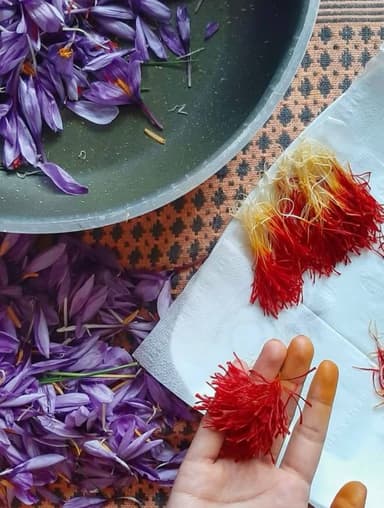
The value of saffron in Iran was never limited to the final product alone. It lies equally in this long historical trajectory, in the specific agricultural knowledge built up over generations around planting, harvesting, and drying the crop, and in the water systems that made such cultivation possible in an arid region in the first place.
The qanat, an underground channel system that carries groundwater across long distances without mechanical pumps, is itself a distinct part of Iran's engineering, recognized internationally as an agricultural heritage system (FAO, 2018). Because of this system, saffron farming has taken root and endured for centuries in the dry landscape of Khorasan.
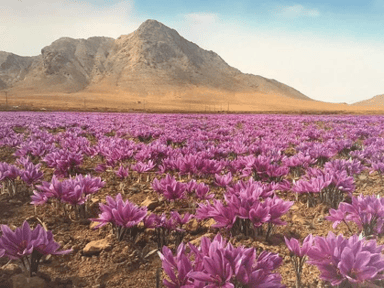
In saffron-growing regions, the harvest season is closely tied to collective memory and the seasonal rhythm of community life. From late October to mid-November, when called "Fasle Gol," meaning the season of Flower, families leave home for the land farms before sunrise to pick flowers. Then their homes become shared spaces for separating and drying the stigmas. Even the family members who have moved to larger cities may return for the harvest, turning the season into an occasion for reunion as well as agricultural work. The scent of saffron also fills local markets and excites everyone.
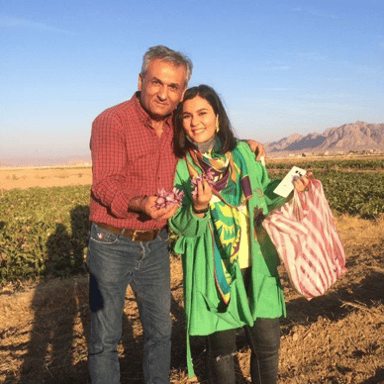
Saffron holds such an important place in Iranian food culture that it appears in a wide range of dishes, sweets, and even drinks. Its meaning, however, goes beyond taste and colour. For many Iranians who leave the country, a small amount of Iranian saffron often finds its way into their luggage. Used later in familiar foods far from home, its smell, colour, and taste can recreate a sense of familiarity and strengthen the emotional connection to home and cultural belonging.
No comments yet. If you know this ingredient — where to find it, how to use it, what it is called elsewhere — please add what you know.
