


Qorut Birjandi
Overview
Qorut Birjandi is one of the best-known traditional foods of South Khorasan, and it’s categorized as a dairy-based dish in Iranian cuisine. This dish prepared mainly from ‘’qorut’’, a local dried and fermented dairy product related to kashk. The dish has a thin consistency and is normally eaten by breaking bread into it, a practice known as tilit. Although its liquid form may look like a soup, it is not usually classified as a soup within Iranian food culture. Instead, it belongs to a wider group of Iranian dairy-based dishes.
History & Cultural Significance
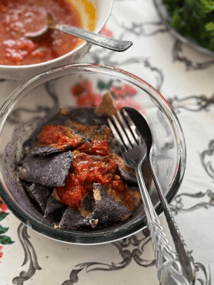
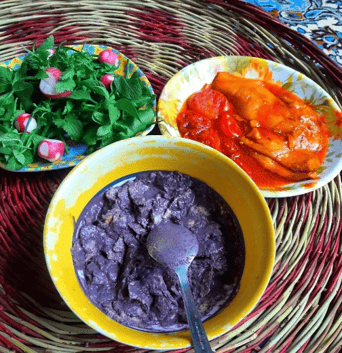
One of the most distinctive features of Qorut Birjandi is its deep purple color. Unlike many purple foods, this color does not seem to come from a naturally purple ingredient, and the exact chemical process behind it has not yet been confirmed through laboratory analysis. Local knowledge nonetheless offers a useful explanation. During field interviews conducted with residents of Qaenat in South Khorasan, local people linked the purple color to the interaction between qorot, walnuts, and the traditional cast iron vessel used in preparation. A seller of traditional food products in this city added that the way qorot itself is produced may also shape the final color, since qorot made in an iron vessel is said to give a stronger purple tone when later used in the dish. These explanations should be understood as local knowledge rather than confirmed chemistry. Even so, the proposed mechanism is plausible, since walnut tannins are known to bind and chelate iron ions, a reaction that can noticeably change colour (Karamać, 2009). Further chemical analysis of Birjandi qorot would still be needed to identify the exact process at work.
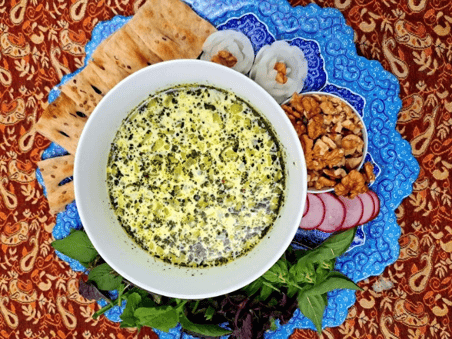
Qorut Birjandi is not exclusive to Khorasan, and different variations of the dish can also be found in other parts of Iran. Similar preparations appear in other regions under names such as kal joosh, kaleh joosh, mast joosh, doogh garmeh, qareh to, and qatreh to. Ingredients and methods differ from one region to another. For example In Sabzevar, a related dish is made with a local dairy product called kameh, which is a very thick yogurt, and the dish is called Kame joosh. Other regional versions rely on yogurt, doogh, or kashk as the main dairy base. This range of names and recipes suggests that the dish is not a single standardized food, but rather a family of related practices shaped by local dairy traditions and available ingredients.
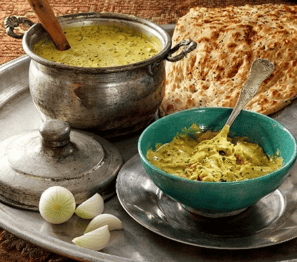
The exact historical origin of Kal Joosh or Qorot cannot currently be established, and the available evidence does not support tracing the dish itself back to ancient Iran. A clear written record does appear, however, in the Qajar period, in Sofreh ye At'emeh (Elahi, 2010). In this text, Kal Joosh appears as the first dish in one of the listed meal arrangements and is described in three forms. The first combines ground kashk with walnuts, fried onion, and fried mint. A second version includes Stewing meat called qormeh, while a third combines legumes such as split peas or lentils with meat. A regional variation associated with Zanjan also adds rice. This Qajar record matters because it shows that Kal Joosh was already an established dish with several variations by the nineteenth century.
Understanding the longer history of this food requires attention to its main ingredient, kashk, a preserved dairy product made from sheep, goat, or cow milk. For this reason, a separate section of this thesis is devoted to a more detailed examination of kashk.
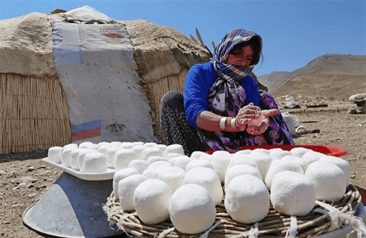
Traditional versions of qorut usually rely on a small number of ingredients, including kashk or another fermented dairy product, onion, garlic, local herbs such as mint, bread, and, where available, walnuts. Historically, this made qorot well suited to households where costly ingredients such as large amounts of meat or rice were less accessible. Bread was a major staple food among ordinary people at a time when rice was more closely linked to wealthier tables, so liquid dishes eaten by soaking or breaking bread into them were common across wider parts of society. This does not mean that qorot belonged only to poor families, since kal joosh, a different form of qorot, appears in a Qajar court cookbook. This evidence shows that it was also known in more formal culinary settings. The simple basic structure of this dish made it highly adaptable to different households and social groups. The dish could also be expanded with locally available ingredients in a given region or household. For instance, the dish might be served with fried eggs, fried eggplant, cooked tomatoes, herbs, and other local products as a side, and make the dish even more nutritious.
Qorot Birjandi in Iran is considered cultural heritage. The dish and the practices connected to it were registered in 2018 on Iran's National List of Intangible Cultural Heritage (cgie, 2018). This recognition aligns closely with UNESCO's criteria and understanding of intangible heritage as living knowledge and practice rather than a fixed object (UNESCO, 2003). This recognition means the cultural value of Qorot does not lie only in the final dish. It also includes the knowledge of producing and preparing kashk, the skill needed to grind and dilute it correctly, the use of traditional utensils, the choice of local ingredients, and the ways these practices are passed down between generations.
Its heritage value is also closely tied to regional identity. Qorot has become one of the foods most strongly associated with South Khorasan and is used to represent the region at cultural events and public gatherings. Reports connected with its heritage registration describe Qorot as a marker of local identity and mention public events where large numbers of people gather around a shared purple sofreh to eat the dish together. Such events show how an everyday regional food can also become a public symbol through which a community expresses its culinary identity.
Qorot also carries an important social meaning at the household level. Traditional preparation requires dried kashk to be softened and carefully ground in a clay vessel known as a kashk-sāb or tagharcheh, a process that takes time and physical effort.
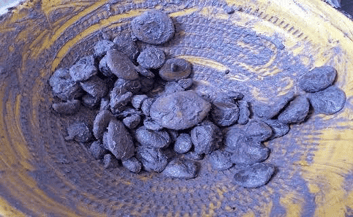
Field interviews indicate that Qorot is therefore often linked to occasions when several family members are present together, and sitting together became part of the memory of the meal itself. This social aspect matters because it shows that the dish's meaning reaches beyond nutrition. The effort involved in preparing the food, sitting around the sofreh, and the collective act of eating all contribute to its place in family memory.
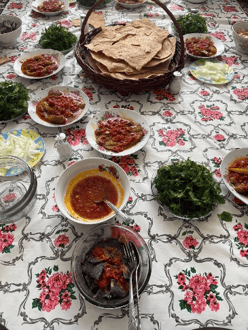
These practices are nevertheless changing. Globalization and urbanization have altered work patterns, access to food products, and the time available for household food preparation. In the case of Qorot, field observations indicate that some households now use commercially processed or pre-ground kashk to avoid the time consuming traditional grinding process. While this makes preparation easier, the final result can differ noticeably from the traditional version, particularly in color, texture, and flavor.
The national recognition of Qorot as intangible cultural heritage is therefore especially relevant here. Preserving Qorot does not simply mean continuing to cook a dish with the same name. It also means keeping the knowledge of how the dairy product is prepared, how it is ground and cooked, how local ingredients and utensils are used, and how the dish continues to function within family and community life.
Ingredients
walnuts
onion
Ghee (clarified butter)
dried mint
Black pepper
Salt
dried traditional bread
eggpalnt
2
Garlic
Vegetable oil
Turmeric
Recipe
Preparation Method
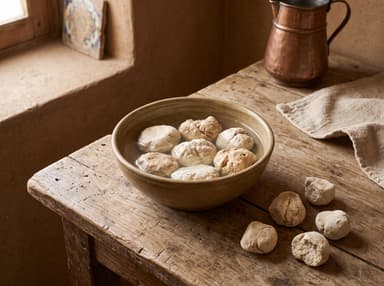
Step 1: Soak the qorut. Place the dried qorut in water and leave it to soak for about 3–5 hours, until it becomes soft.
Step 2: Prepare the walnuts. Grind the walnuts very finely until they begin to release some of their natural oil.
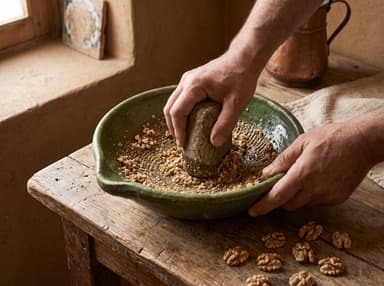
Step 3: Grind the qorut. Traditionally, the softened qorut and walnuts are ground together in a rough clay bowl called a tagharcheh or kashksab. Gradually add a little water while grinding until a smooth, deep purple liquid forms.
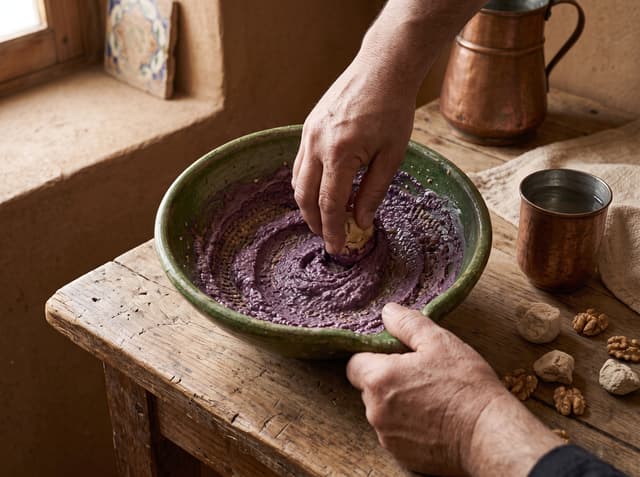
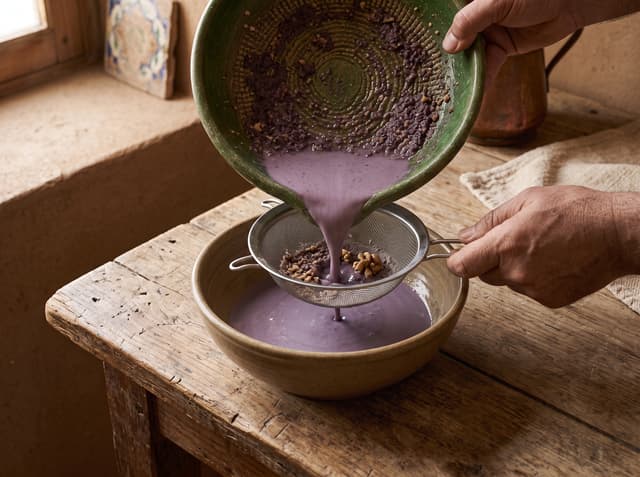
Step 4: Strain the qorut mixture. Add the remaining water, mix well, and strain the liquid to remove any solid pieces. Set the purple qorut liquid aside.
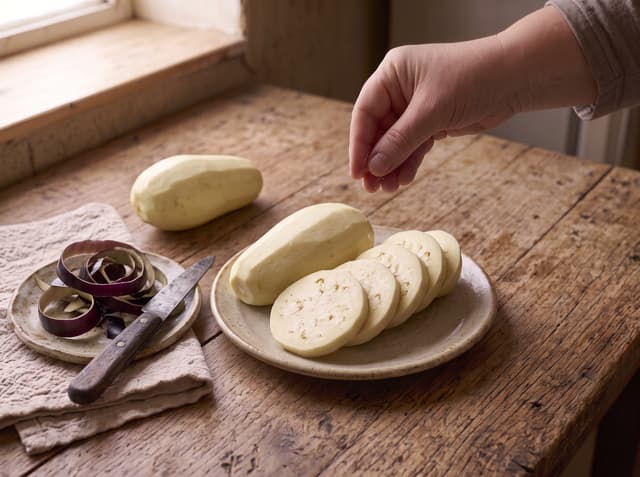
Step 5: Prepare the eggplant. Slice the eggplants, sprinkle them lightly with salt, and leave them for about 15 minutes. Pat them dry before cooking.
Step 6: Cook the eggplant. Heat oil in a frying pan and fry the eggplant slices until golden and soft. Remove them from the pan and set aside.

Step 7: Prepare the tomato sauce. In the same pan, fry the chopped onion and garlic until soft and lightly golden. Add turmeric, black pepper, and tomatoes. Cook for about 10–15 minutes until the sauce becomes thick. Check the salt.
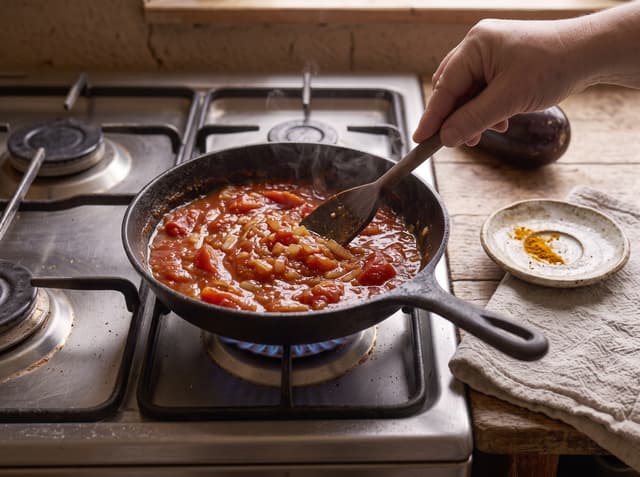
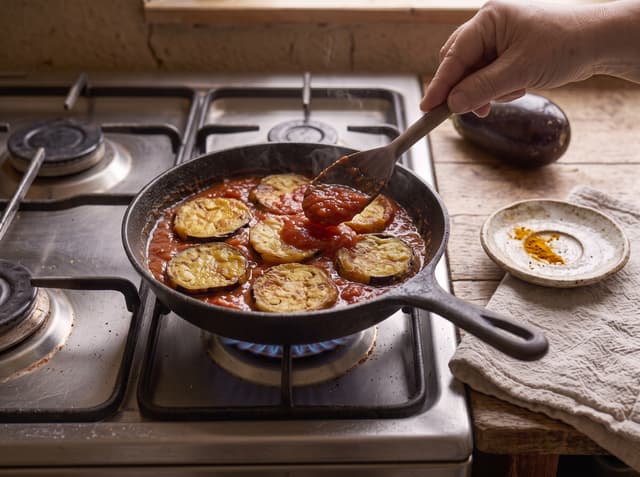
Step 8: Combine the eggplant and tomato sauce. Place the fried eggplant slices in the tomato sauce and simmer gently for about 5 minutes. Keep warm until serving.
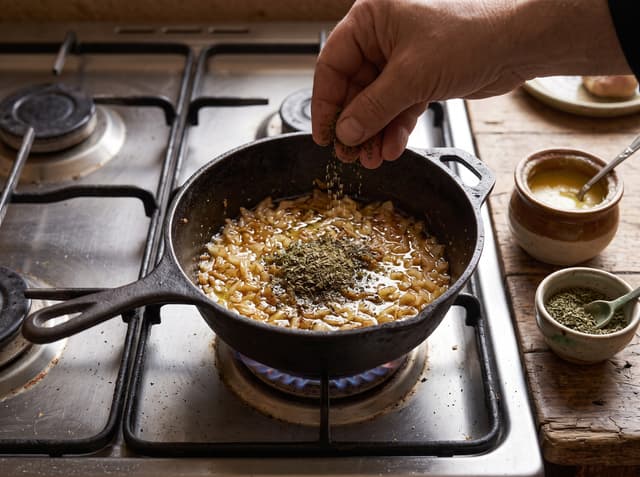
Step 9: Prepare the onion for the qorut. Finely chop the remaining onion and fry it in ghee until golden. Add dried mint and black pepper and cook briefly.
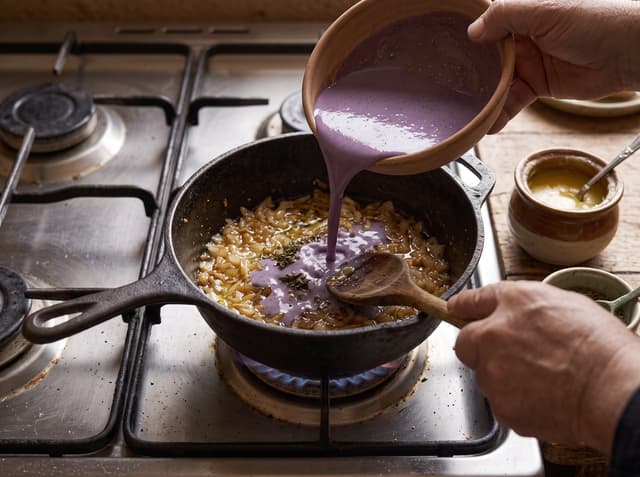
Step 10: Add the qorut mixture. Pour the strained qorut liquid into the pot with the onion and mint mixture. Heat gently while stirring.
Step 11: Heat the qorut briefly. Once the qorut begins to boil, remove it from the heat. Avoid cooking it for too long.
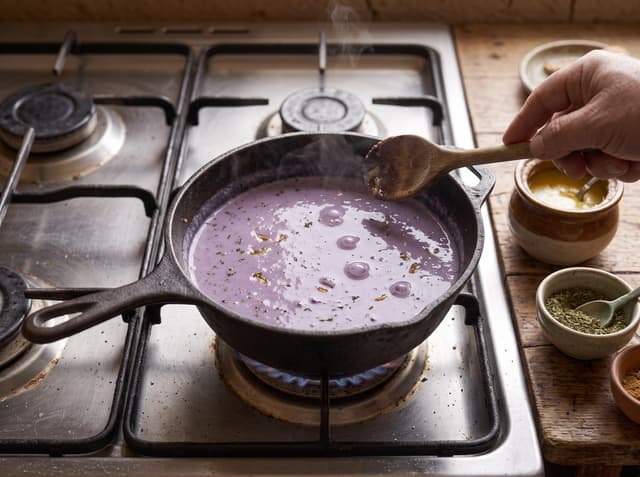
Step 12: Serve. Pour the hot qorut into a serving bowl. Serve with pieces of bread, allowing the bread to absorb the qorut. Place the eggplant with tomato sauce alongside it and serve with fresh herbs if desired.
💡 Chef's Tips
Traditional preparation: Grinding the qorut and walnuts in a tagharcheh helps release the walnut oil and creates a smoother texture.
Do not overcook the qorut: Remove it from the heat shortly after it reaches a boil.
Eggplant: Frying gives the most traditional rich texture, but the eggplants can also be roasted for a lighter version.
Tomato sauce: Cook the tomatoes until the sauce is thick rather than watery, so it works well as a side dish.
Ingredients and equipment: Using a cast-iron pot and good-quality kashk can help produce a more appealing color in the final dish.
References
- 12018
Qorut Was Nationally Registered
by cgie
Retrieved from Center for the Great Islamic Encyclopaedia.
- 22010
KALLAJUŠ
by Elahi, E.
Retrieved from Encyclopaedia Iranica.
- 32009
Chelation of Cu(II), Zn(II), and Fe(II) by Tannin Constituents of Selected Edible Nuts
by Karamać, M.
https://doi.org/10.3390/ijms10125485International Journal of Molecular Sciences.
Music
Comments
No comments yet. If you know this dish — how your family makes it, what it is served with, when it appears — please add what you know.