
Listen to pronunciation
Kashk is a fermented dairy product well known in Iranian food culture, made from the buttermilk left over after butter has been separated. This liquid is first boiled down and thickened, then salted, shaped, and dried until most of its moisture is gone. This moisture loss allows kashk to be stored for a long time without refrigeration.
The ability to store kashk for a long time made it a practical solution for pastoral life, since during seasonal movement and frequent travel, carrying fresh milk was difficult, while kashk was lighter and easier to transport and still retained much of the milk's original nutritional value. Taking kashk into modern laboratories also confirms its nutritional value. Analyses show kashk is a notable source of protein and calcium, and carries useful lactic acid bacteria and can act as a source of probiotic activity.
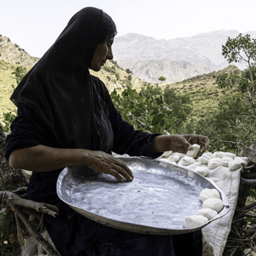
The connection of preserving milk to pastoral life has deep roots in the Iranian Plateau. However, the exact time and place where kashk was first used cannot be established with certainty; evidence from biological residues shows that dairy exploitation on the Iranian Plateau goes back to the seventh millennium BCE. Kash itself can broadly be linked to the Iranian Plateau, Central Asia, Anatolia, and the Middle East. The word kashk holds an old place in Iranian historical and literary texts. Linguists trace its root to Middle Persian, and note that the word also appears in a Sassanian text called Xusraw ud Rēdag, though there it carries a different meaning, referring to flour or bread, rather than the dairy product known as kashk in Iran today. Among the Pashtuns of Afghanistan, the word kashk also refers to a cereal broth or bread soup, not a dairy product.
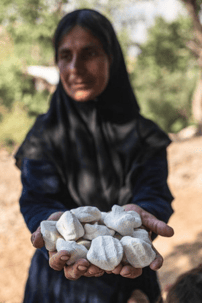
Linguists believe that the word kashk was borrowed into some Arab countries, including Iraq, Syria, and Egypt, from Persian, though it took on different meanings there. Ibn al-Sayyar, the author of one of the oldest cookbooks from the 10th century, mentions numerous compound terms built from the root keškiya, referring to dishes common in Iraq at the time, which he classified by their main ingredient, such as wheat; by taste, such as sour; and by region. Later texts mention varieties such as kešk khorāsāni, meaning of the East, and kešk bābeli, meaning of Babylon, alongside kešk ahmar, made with leaven, and kešk laban, made with curdled milk. A dish called kešk mosabba'un, meaning seven ingredients, is also mentioned as a variety prepared for the Mamluk kings of Egypt, though its exact ingredients were not recorded. Among Egyptian farmers of the seventeenth century, kešk was a common dish made from curdled milk, flour, and honey, similar in nature to halva.
What can be concluded from the use of this word across Iran and different countries is that kashk likely referred to foods made from simple base ingredients such as grain and milk, rather than to one single, fixed product. Even so, no reliable historical source gives a precise account of kashk and its development before the nineteenth century. Modern sources offer a clearer definition of kashk across Iran, referring to the same dairy product introduced at the start of this text.
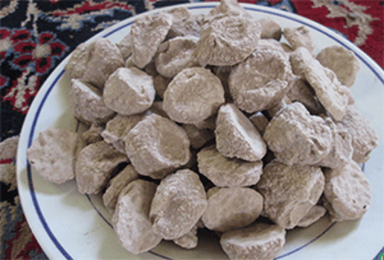
The similarity between the terms and products related to kashk among speakers of Iranian languages, aside from Pashto and Baluchi, and speakers of Turkic languages, points to mutual influence between these two language groups in spreading both the word and the product itself. Even so, some differences remain. Among Kurds and Turks, the word kashk refers to a soft product, while among speakers of other Iranian languages, as well as the Azeris, the same word refers to a dry product. This word family reaches even further than the Iranian and Turkic language groups. Terms such as keš or keş, meaning sour curd, keškek or keşkek, a wheat based dish, and keškina or keşkina, a type of barley preparation, also appear in Altaic languages, showing that the reach of this word family extends well beyond the Iranian Plateau and Anatolia.
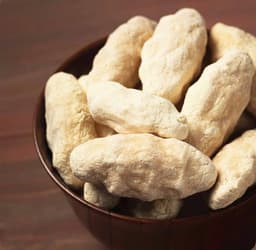
Since kashk is not simply a food item, but a product shaped by adaptation to climate and way of life, it is natural that different regions, depending on locally available ingredients and resources, would develop different raw materials or preparation methods, giving each province or region's kashk a different shape, taste, texture, or color. This regional variation is also examined scientifically, showing traditional differences across varieties. These differences include fat content, mineral levels, free amino acids, and vitamins, which mainly come from the type of milk and other ingredients such as wheat, flour, and herbs used in kashk production (Iranmanesh, et al, 2023). In this sense, kashk is better understood as a family of related regional foods rather than a single standardized product. Kashk-e zard, meaning yellow kashk and associated mainly with eastern and southeastern Iran, is a clear example of this. Unlike the plainer white kashk, it typically includes fermented yogurt, wheat flour, herbs, spices, and salt, and its preparation runs through several separate stages of fermentation and drying, combining dairy preservation with a cereal-based food tradition in a single product.
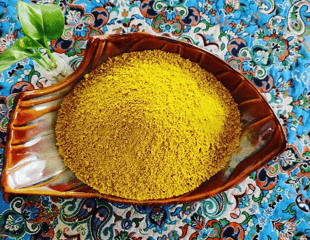
The way kashk is used also differs from one region to another. Some households grind dried kashk into powder and add water to make a paste from it. In other regions, special clay vessels known as kashk-sab are used, where kashk is rubbed against the sides of the vessel with the help of water until the final product is ready. Another common method is soaking kashk in water for a period of time until it softens, after which it is ready to use.
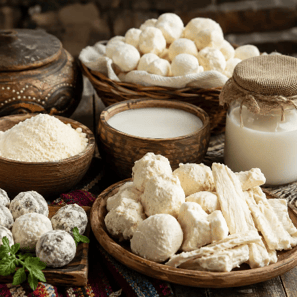
Kashk's place at the Iranian table also has a documented literary history. Kamāl al-Din Esmāʿil, a 12th-century poet, refers in a poem to a dish called kal joosh, whose main ingredient is kashk, and describes it as a food eaten by poor families of his time. In some Iranian cities, such as Sabzevar, the same dish is still associated with poorer families, largely because its ingredients were accessible and inexpensive. However, the recipe for this dish, along with several of its variations, is also recorded in the cookbook Sofreh ye At'ema, a collection of Qajar era court recipes, which shows that this was never purely a food of the poor, since it was also served at court.
Kashk has secured such a firm place in Iranian cooking, whether as a main ingredient, a seasoning, or even, in some cases, a snack, that today, even though preserving milk is no longer as difficult as it once was, kashk is still produced through mechanized methods and in large volumes, and sold across the whole of Iran. Kashk e bademjan, in which kashk is served with fried eggplant, and āsh e reshteh, in which kashk is used for seasoning, are among the best known examples of this use in Iranian cooking today. While modern production methods help preserve the final product, the traditional methods of preparing kashk are just as important and deserve protection in their own right. Protecting these traditional methods also protects the authenticity of certain dishes, since in many foods the true color, taste, and texture emerge only when the kashk used is prepared and applied in the traditional way.
No comments yet. If you know this ingredient — where to find it, how to use it, what it is called elsewhere — please add what you know.
